Did Giotto draw a perfect circle? What Vasari wrote, and how long after
It is the best-known story about any painter of the Middle Ages, it is told in every classroom, and it appears in exactly one place: a book published in Florence in 1550 by a painter who was born in 1511. Giotto died in 1337. That is the whole problem with it, and it is a more interesting problem than the story.
The story, as Vasari tells it
The pope wants to know how good this painter from Florence really is, so a courtier is sent round the workshops to collect drawings. He asks Giotto for something to take back. In Vasari’s telling, Giotto “took a sheet of paper, and with a pen dipped in red, fixing his arm firmly against his side to make a compass of it, with a turn of his hand he made a circle so perfect that it was a marvel to see it.” The courtier, reasonably enough, thinks he is being mocked and asks whether that is really all he is getting. Giotto’s answer: “This is enough and too much.”
And Vasari finishes with the proverb he says came out of it — “You are rounder than the O of Giotto” — noting that in Tuscan it worked as an insult as well as a compliment, because the same word carried a sense of slowness of mind. The joke is that the phrase praising the most famous draughtsman in Italy was also a way of calling somebody thick.
The arithmetic that the story is usually told without
Giotto died on 8 January 1337. Vasari’s first edition appeared in 1550: subtract, and the gap is 213 years. The enlarged second edition of 1568, which is the one most modern translations work from, is 231 years after. You will often see this described as two and a half centuries, which would be about 250 and is roughly a fifth too generous; two centuries and a bit is the honest figure, and it is quite long enough to make the point.
To put that distance in a shape you can feel: it is the same gap as between a book published today and an anecdote about a painter working in the early 1800s, told by somebody who never met anyone who met him, in a book with no footnotes.
How reliable is Vasari?
He is indispensable and he is not a witness, and both halves of that matter. The Lives is one of the foundations of European art history and a great deal of what we know about sixteenth-century artists comes from a man who knew them. About the fourteenth century he is working from two hundred years of workshop talk. The standard scholarly complaint, in John Addington Symonds’s words, is that Vasari wrote “with carelessness, confusing dates and places, and taking no pains to verify the truth of his assertions”, and of the anecdotes generally: “Many of his anecdotes have the ring of truth, although likely inventions. Others are generic fictions.”
The circle is not the only Giotto story in that category. The other famous one — Cimabue finding a shepherd boy drawing his sheep on a rock, and taking him on — is also Vasari’s, and modern scholars call it a legend (what is actually known about his training). Two stories, one source, the same two-century gap.
“Is it humanly possible to draw a perfect circle?”
Not in the mathematical sense, and neither is it possible with a compass: a perfect circle is a set of points at an exactly equal distance from a centre, and no physical instrument, hand or ink can hold that to an infinite number of decimal places. Anyone answering this question with a straight yes is answering a different one.
What is entirely possible — and what the story is actually describing — is a circle good enough that a trained eye cannot fault it. The method in the anecdote is the real technique, and any draughtsman will recognise it: you do not draw a circle with your fingers or your wrist, you lock the elbow against the ribs and pivot from the shoulder, so the arm becomes a fixed radius. It is a physical trick, it can be learned, and it is how signwriters and animators have drawn freehand circles ever since.
So the honest verdict on the story is this: the feat is real and teachable, the anecdote is a piece of sixteenth-century literature, and the one thing we can check is the wall in Padua. Whatever Giotto did or did not do with a pen in front of a pope’s messenger, he did something considerably harder over two years, on wet plaster, in a room you can stand in for fifteen minutes (what that actually took).
When a guide tells you the circle story — and they will — the useful question is not whether it happened. It is why a story about effortless skill got attached to this particular painter and not another. That answer is on the walls.
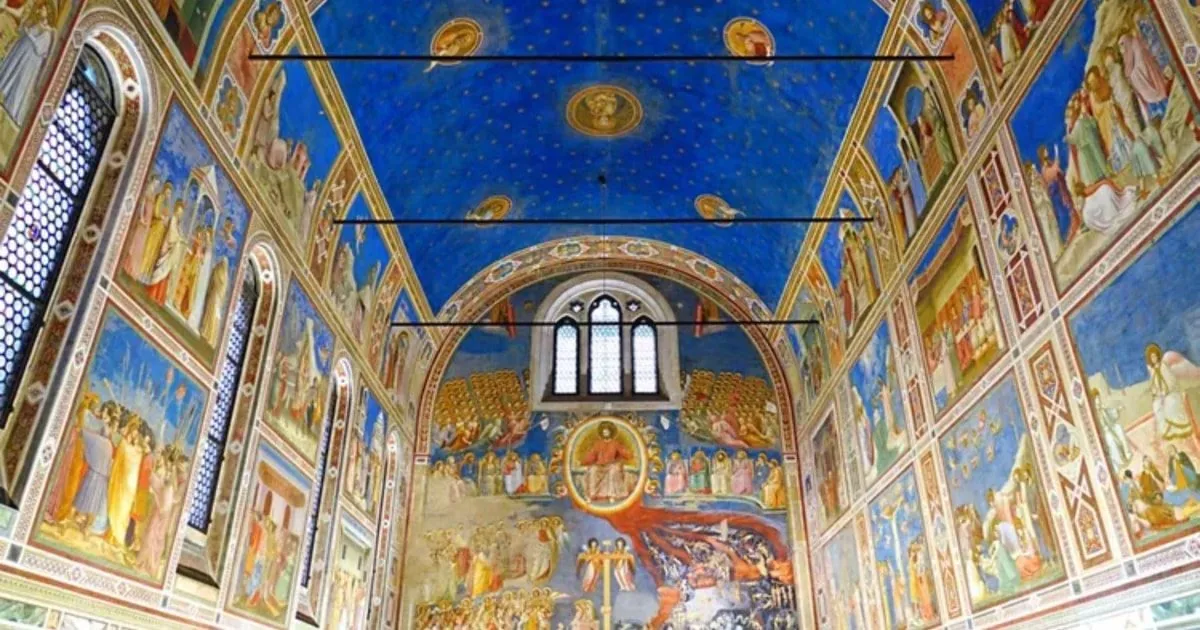 Most-reviewed
Guided Tour of Giotto's Scrovegni Chapel
 Private, priced per head
Padua: Private City Walking Tour & Scrovegni's Chapel Visit
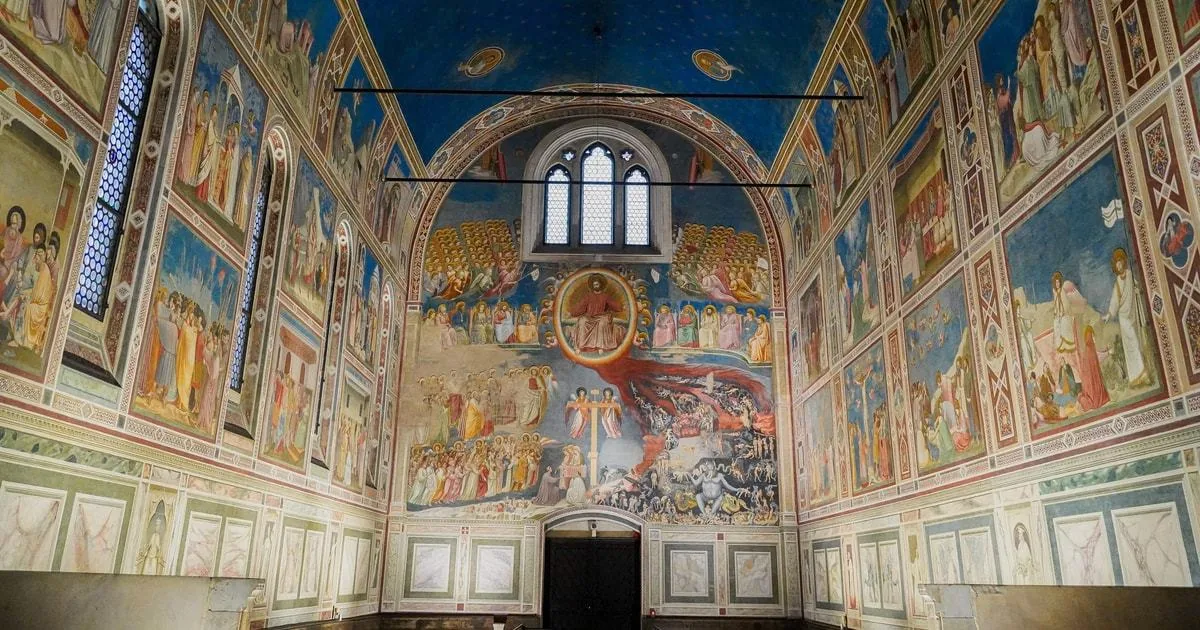 Sacred art of Padua
Padua: Scrovegni Chapel & Basilica with Sacred Art Guide
More: who Giotto was, what he painted here, and the method he had to work in.
Frequently asked questions
Did Giotto draw a perfect circle?
The story comes from Giorgio Vasari’s Lives, published in 1550. Giotto died in 1337, so it was written 213 years after his death, and there is no contemporary record of the event. It is a story about Giotto rather than a documented episode — which makes it good evidence about his reputation and no evidence at all about a particular afternoon.
What is the story of Giotto’s O?
A pope’s messenger asks Giotto for a sample of his work. Giotto, in Vasari’s words, took paper and a pen dipped in red, fixed his arm against his side “to make a compass of it”, and drew a circle so perfect “that it was a marvel to see it”. Asked for more, he said: “This is enough and too much.” Hence the Tuscan proverb about being rounder than the O of Giotto, which doubled as an insult.
Is it humanly possible to draw a perfect circle?
Not in the mathematical sense — and not with a compass either, since a perfect circle is an infinite set of exactly equidistant points. What is possible is a circle no eye can fault, drawn the way the anecdote describes: elbow locked against the ribs, pivoting from the shoulder so the arm works as a fixed radius. It is a learnable physical technique.
Is Vasari a reliable source on Giotto?
He is indispensable and he is not a witness. He was born in 1511 and published in 1550, two centuries after Giotto’s death, and the standard criticism is that he wrote “with carelessness, confusing dates and places”. His other famous Giotto story, Cimabue discovering the boy drawing sheep, is called a legend by modern scholars. What is actually documented.