What Giotto painted in the Scrovegni Chapel: three tiers, a blue vault, and fourteen figures pretending to be carved stone
You get about fifteen minutes in this room. Almost everything that goes wrong in those fifteen minutes is a reading problem: people start at the top left, work along like a page of text, and are somewhere in the middle when it ends. The room is not organised like a page. It is organised like a spiral.
How to read the room
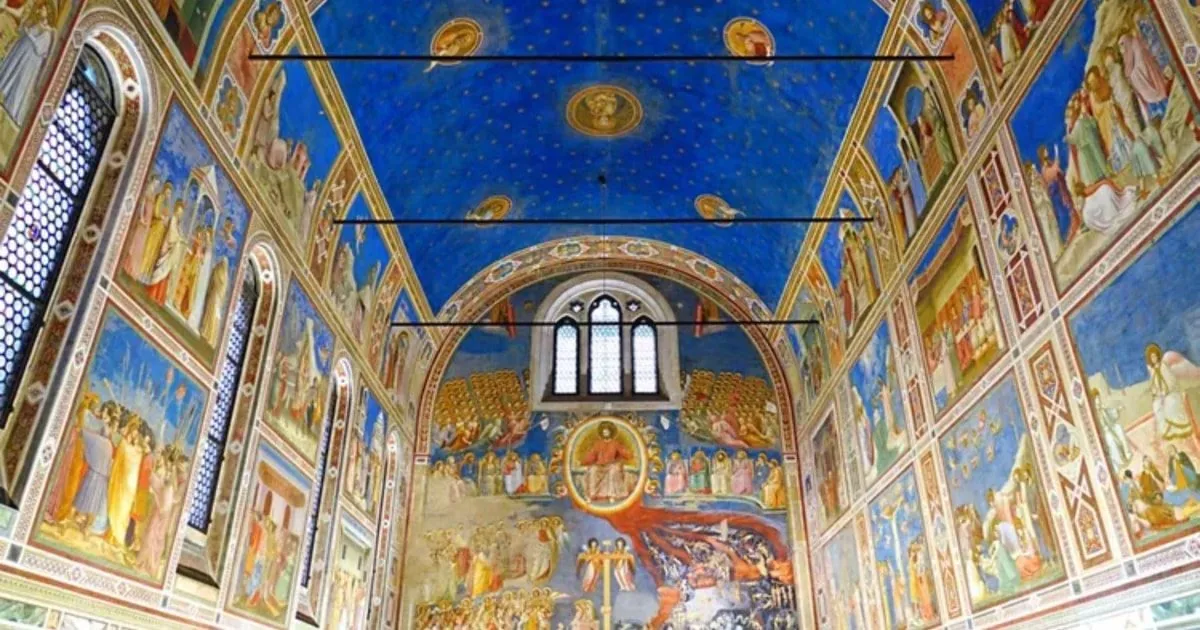
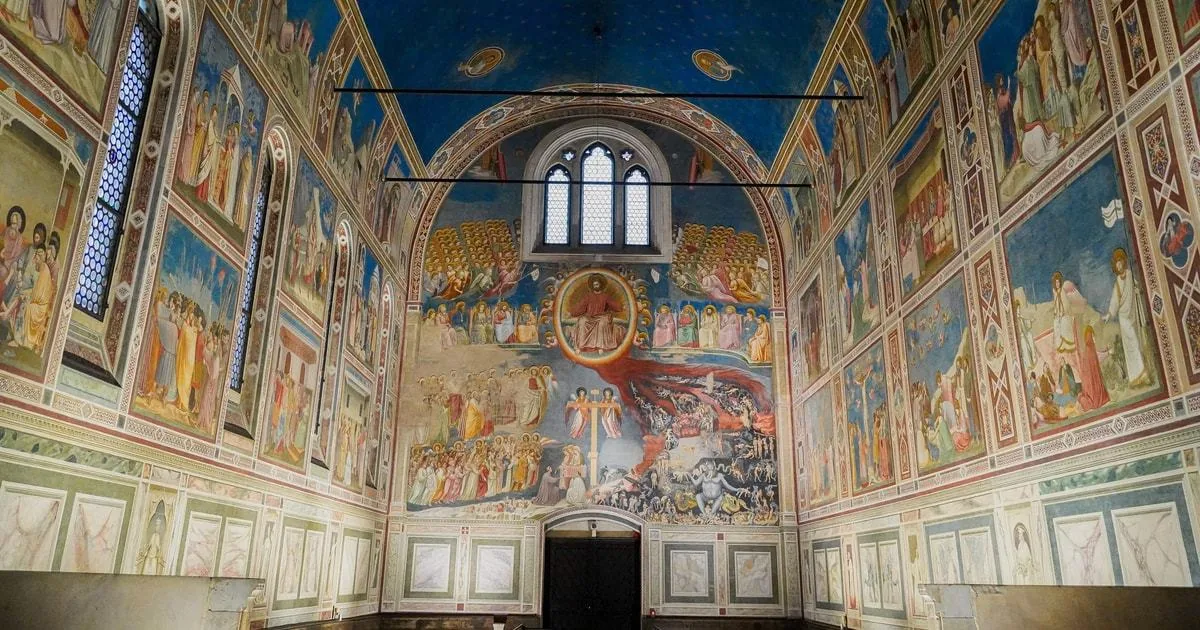
Stand facing the altar. The story begins in the top band, at the altar end of the right-hand wall, and runs round the room in that band before dropping to the band below and running round again, and again. Three circuits, top to bottom, and the chronology of the whole Christian story is laid out in the order you would walk it. At the altar end, on the chancel arch, is the Annunciation. At the other end, on the wall you came in through, is the end of everything (that wall, in full).
What that layout means in practice, when the clock is running: do not try to follow the narrative. You will not finish it. Pick a band, or pick four panels, and give them the time properly. The people who leave this room happiest are the ones who looked hard at a few things.
The top tier: Joachim, Anna, and the life of the Virgin
The cycle opens before the Gospels do, with the Virgin’s parents — Joachim turned away from the temple, Joachim among his shepherds, Anna receiving the news — and then moves to Mary’s own childhood and marriage. This is the part of the room fewest visitors know in advance and the part where Giotto is most obviously enjoying himself: ordinary people doing ordinary things in front of little buildings that behave like real boxes with real insides.
The middle tier: the life of Christ
The second circuit is the Gospel story proper — the Nativity, the Adoration, the Flight into Egypt, the Baptism, the raising of Lazarus. It is where most people recognise something, and where the thing everybody has been told about Giotto becomes visible: faces that are reacting to each other rather than facing out, and bodies with weight under their clothes (what exactly changed).
The bottom tier: the Passion, and the two heads
The lowest band is the arrest, the trial, the crucifixion, the Lamentation and what comes after. It is at the most comfortable height to look at, it is the most famous part of the room, and it contains the single image from this chapel that has been reproduced more than any other.
Beside it, the Lamentation: the dead Christ on the ground, the Virgin holding his face, and a row of angels overhead doing something no earlier painter had asked angels to do, which is grieve visibly and untidily. If you have fifteen minutes and no plan, these two panels are the plan.
The vault
Look up first, before anything. The barrel vault is a star-studded blue sky with medallions set into it holding Christ, the Virgin and other figures. In photographs it is a decorative ceiling; in the room it is the reason the space feels like a space, because the blue is not a background colour, it is a depth. It is also the most expensive surface in the building, and there is a whole page in that (where the blue came from and why it was laid on dry).
The fourteen at eye level
Along the dado, below the narrative bands, stand fourteen figures painted in grisaille — monochrome grey, imitating carved stone, in imitation niches. Seven Vices run along the north wall and seven Virtues face them from the south: Charity, Justice, Envy, Despair, Folly and the rest, each with its Latin name. They are the only things in the room at the height of your own eyes, which is presumably the point: the narrative is above you and the moral choice is level with you.
They are also a joke about painting, and a confident one. A painter who has spent two years demonstrating that paint can make a convincing world then paints fourteen sculptures that are not there.
“How many scenes are in the Scrovegni Chapel?”
There is no single agreed number, and the reason is more interesting than the figure. You will find three different totals in three different books, depending on whether the author counts the panels on the chancel arch, whether the Annunciation is one scene or two, and whether the Judgement counts as a panel or as a wall. The operator’s own pages, which are the authority this site defers to, do not print a count at all.
So the honest description of the long walls is the one this page has been using: three tiers of narrative panels, plus the fourteen grisaille figures along the dado, plus the vault, plus the Judgement on the entrance wall. If a page gives you a confident total, ask it which of those three decisions it made. It probably did not make any of them on purpose.
The one thing to fix before you go in: know that the story runs top band first, all the way round, then down. Everybody who reads it wall by wall instead of band by band comes out confused about the chronology, and there is no time in there to work it out.
What to look at, in order, with a quarter of an hour
- The vault. Thirty seconds, straight up, before your eyes adjust to the walls.
- The Lamentation and the Kiss of Judas, in the bottom band. The two panels you will recognise, at the height you can actually see them.
- One panel from the top band — Joachim among the shepherds, if you can find it — for the contrast with what you have just been looking at.
- Two of the grisaille figures, close up, to see how the fake stone is done.
- Turn round. The entire entrance wall. Give it the last two minutes (and read it beforehand).
 Most-reviewed
Guided Tour of Giotto's Scrovegni Chapel
 Sacred art of Padua
Padua: Scrovegni Chapel & Basilica with Sacred Art Guide
 Capped at ten
Padua: Small-group walking tour with the Scrovegni Chapel
Further in: who painted it, how a fresco is actually made, the blue, the wall behind you, and how to spend the fifteen minutes.
Frequently asked questions
What did Giotto paint in the Arena Chapel?
The whole interior, between 1303 and 1305: three tiers of narrative panels on both long walls, running as a descending spiral from the lives of Joachim and Anna and the Virgin at the top, through the life of Christ, to the Passion at the bottom; a barrel vault painted as a blue sky full of stars; fourteen grisaille figures along the dado; and the Judgement filling the entrance wall.
What are the Giotto frescoes in the Scrovegni Chapel?
One continuous programme covering every surface of a small private chapel, painted for Enrico degli Scrovegni. The best-known individual panels are the Lamentation and the Kiss of Judas, both in the lowest band, where they are at eye level and easiest to look at in the fifteen minutes you get.
How many scenes are in the Scrovegni Chapel?
There is no settled total, and this site does not print one. Different books count differently depending on whether the chancel-arch panels are included, whether the Annunciation is one scene or two, and whether the Judgement is a panel or a wall. The operator’s own pages give no count. What is certain is three tiers of narrative panels on each long wall, fourteen grisaille figures on the dado, the vault, and the Judgement.
In what order should I look at the Scrovegni Chapel frescoes?
The story runs in bands, not walls: the top band all the way round the room first, then the middle, then the bottom. With fifteen minutes, do not try to follow it. Look up at the vault, then give the Lamentation and the Kiss of Judas real time, then turn round for the entrance wall before you leave.
What are the grey figures at the bottom of the walls?
Fourteen personifications painted in grisaille — monochrome grey imitating carved stone in imitation niches — with seven Vices along the north wall and seven Virtues facing them from the south. They are the only figures in the chapel at the height of your own eyes.
Can you take photographs inside the Scrovegni Chapel?
The resold ticket listing states that large bags and flash photography are not allowed, and reviewers describe leaving bags in lockers before going in. The safest assumption is no flash and no large bag, and the fifteen minutes are short enough that a camera costs you most of them anyway.