Who Giotto was, and what painting did after him
Giotto di Bondone was born near Florence around 1267 and died on 8 January 1337. Between those dates European painting changed in a way that is still visible to a person with no training whatever, and the clearest single place to see it is a small brick box in a garden in Padua.
What changed, in terms you can check with your own eyes
Four things, and you can test all four against the walls in Padua inside your fifteen minutes.
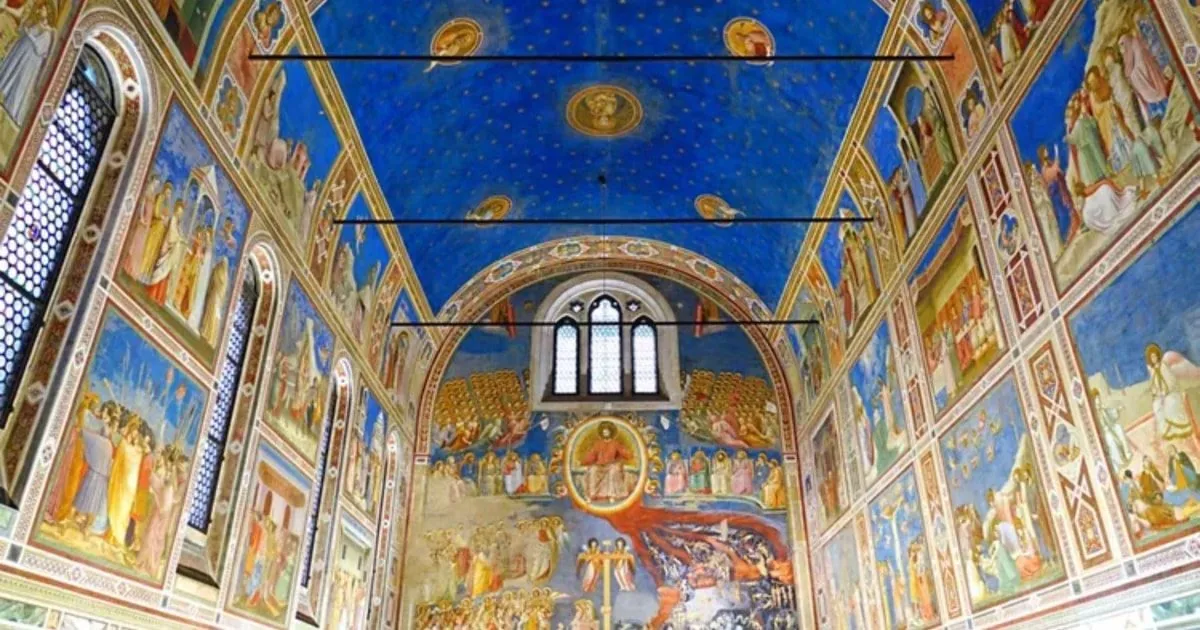
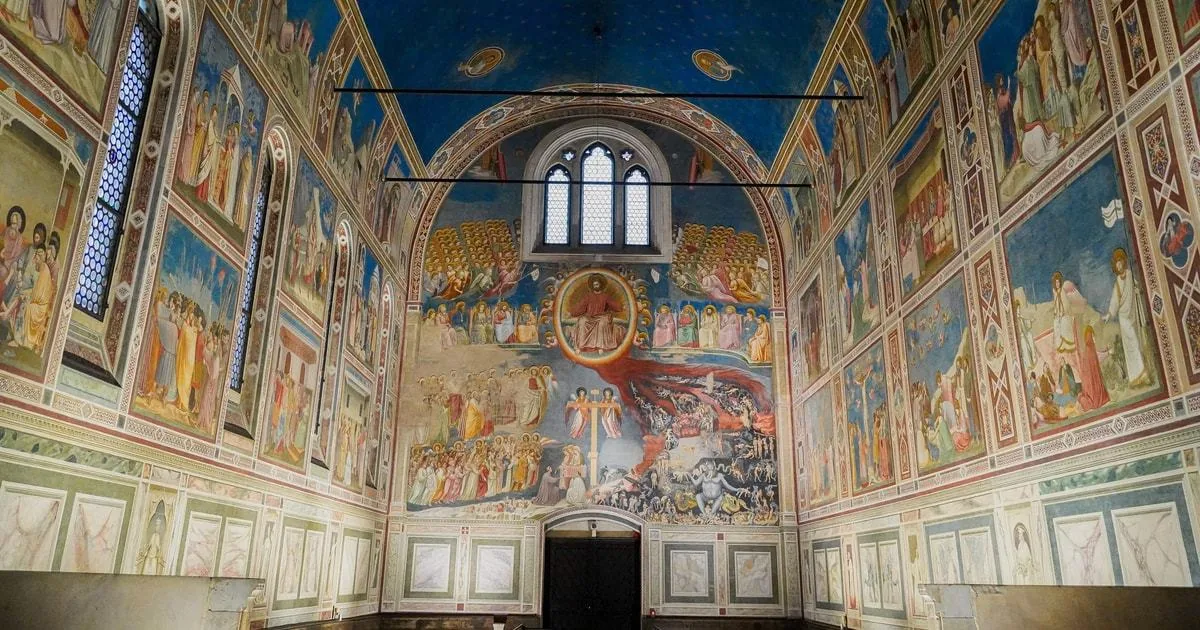
Weight. The bodies have mass. Drapery falls over a shape that is underneath it rather than describing a pattern on the surface, and figures stand on the ground as though the ground were holding them up.
Space that behaves. The little buildings in these panels have insides. Walls have thickness. A figure standing behind another figure is behind them, not above them. It is not perspective in the fifteenth-century sense — that is a hundred years off — but it is a painter deciding that a picture is a place.
Faces doing something. Earlier wall painting gives you figures presenting themselves to the viewer. Giotto gives you people looking at each other. The Kiss of Judas works because two faces are at close range and one of them is making a decision (where to find it).
Grief that is not decorous. The angels over the Lamentation are twisting and clutching in a way that has no precedent in the painting that came before this room. That is the part reviewers describe when they say the chapel got to them, even when they do not put it in those words.
Dante names him, while he is alive
The best evidence that Giotto’s contemporaries knew what they had is not from an art historian, because there were none. It is three lines in the Purgatorio, canto XI, written while the paint in Padua was barely dry:
Credette Cimabue ne la pittura
tener lo campo, e ora ha Giotto il grido,
sì che la fama di colui è scura.
— “Cimabue believed that he held the field in painting, and now Giotto has the cry, so the fame of the former is obscure.” Dante’s subject in that canto is pride and how quickly reputation turns over, so it is not a compliment so much as an illustration. But it tells you plainly that in the first decades of the fourteenth century, an educated Italian would have understood the name.
“Who taught Giotto to paint?”
The expected answer is Cimabue, and the documented answer is that nobody knows. The Cimabue story comes from Giorgio Vasari, who wrote it in the Lives of 1550: Cimabue, passing, finds a shepherd boy drawing his sheep on a rock, the drawings are so lifelike that he asks to take the boy as an apprentice. It is a lovely story and modern scholarship calls it a legend.
Two things follow from that. First, Vasari was writing more than two hundred years after Giotto died, and his own reputation among historians is that he confused dates and places and took no pains to verify his assertions — a scholar’s phrasing, not this site’s. Second, Dante’s three lines pair the two names, so the association is at least as old as the poem, which is much older than Vasari. A link between them in the public mind is documented. A teacher-and-pupil relationship is not. The other famous Giotto story is Vasari’s too.
“What is Giotto’s most famous work?”
This chapel, and for a reason better than fame: it is the most complete cycle whose attribution to him nobody argues about. Other major works carry real scholarly disputes about how much of them is his hand and how much his workshop’s. Padua does not have that problem, which is why it is the room every account of him is built around.
Outside painting, the thing of his that most people have seen without knowing it is in Florence: in 1334 he was appointed chief architect of the cathedral, and the bell tower begun on 18 July that year still carries his name. He died three years later.
Five things worth knowing about him
- He was famous young and stayed famous. No rediscovery, no neglected centuries. The line runs unbroken from Dante to Vasari to now.
- He worked fast. The whole of the Scrovegni interior took two years, and 625 days’ work at the plaster (what a day’s work means).
- He was an architect at the end of his life, not only a painter, and Florence gave him the cathedral in 1334.
- Two of his best-known stories are Vasari’s — the sheep and the circle — and both were written more than two centuries after his death.
- His patron here was a money lender whose father Dante had put in Hell, which is a fact about the fourteenth century as much as about either of them (the Scrovegni family).
 Most-reviewed
Guided Tour of Giotto's Scrovegni Chapel
 Sacred art of Padua
Padua: Scrovegni Chapel & Basilica with Sacred Art Guide
 Private, priced per head
Padua: Private City Walking Tour & Scrovegni's Chapel Visit
Next: what he painted here, tier by tier, the circle story, examined, how the painting was physically done, and why this room matters.
Frequently asked questions
Did Giotto paint the Scrovegni Chapel?
Yes — the whole interior. The operator’s own words are that the chapel “was frescoed between 1303 and 1305 by Giotto, upon the commission of Enrico degli Scrovegni”. It is the most complete cycle whose attribution to him is not disputed, which is why it is the room every account of his work is built around.
Why is Giotto so important?
Because painting after him puts figures in a space with weight and lets them react to one another, and painting before him mostly does not. UNESCO’s citation for Padua’s fourteenth-century fresco cycles says his work here “marked the beginning of a revolutionary development in the history of mural painting”. The full citation.
Who taught Giotto to paint?
Nobody knows. The traditional answer, Cimabue, comes from Vasari, writing in 1550 — more than two hundred years after Giotto died — and modern scholars call his story of Cimabue finding the boy drawing sheep a legend. Dante does pair the two names in the Purgatorio, but that records a reputation, not an apprenticeship.
What is Giotto’s most famous work?
The Scrovegni Chapel in Padua, painted between 1303 and 1305. Individually, the Lamentation and the Kiss of Judas from that cycle are the most reproduced. In architecture, the bell tower of Florence cathedral, begun on 18 July 1334 after he was made the cathedral’s chief architect, still carries his name.
When did Giotto live?
He was born around 1267 near Florence and died on 8 January 1337. Dante, a contemporary, names him in the Purgatorio, which means he was already the most talked-about painter in Italy while he was working in Padua.
Are there other Giotto frescoes to see in Padua?
Padua’s UNESCO listing covers eight complexes of fourteenth-century fresco, by six named painters, of which Giotto’s chapel is the first. The other cycles are by Guariento di Arpo, Giusto de’ Menabuoi, Altichiero da Zevio, Jacopo Avanzi and Jacopo da Verona. Where they are.